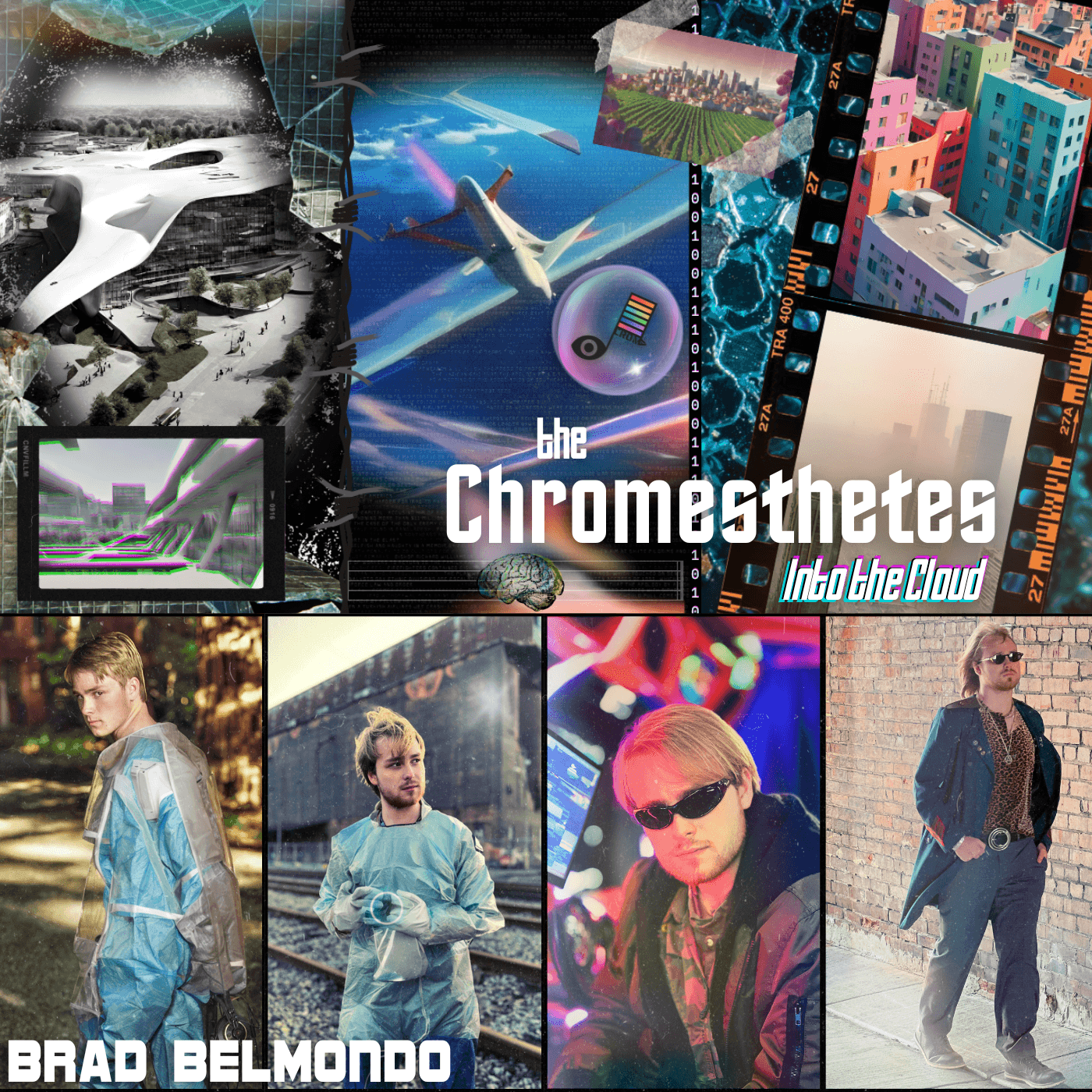




The Chromesthetes: Into the Cloud
Designed as a fully immersive, long-form listening experience, the album unfolds as a first-person journey through a near-future North America shaped by a technocratic oligarchy and a vast neural network known as The Cloud. Told entirely through sound, it blends synthesizers, full orchestra, experimental electronics, genre-shifting compositions, cinematic sound design, field recordings, AI voices, and SFX into a single uninterrupted narrative.
The listener is not observing a story—they are placed inside it.
Over the course of roughly an hour and a half, the album traces the emotional and psychological arc of a person growing up in this world: living through collective trauma, absorbing propaganda and beauty in equal measure, entering The Cloud, and traveling through its promise, seduction, and consequences. The environment changes constantly—sometimes intimate and fragile, sometimes overwhelming and mechanized, sometimes eerily calm.
There are no visuals.
Yet the album is meant to feel visual.
Like a film without a screen, The Chromesthetes invites the listener to construct the world internally: cities, memories, systems, and landscapes emerge purely through sound. Motifs recur and evolve. Textures gain meaning. Silence becomes narrative. Music, noise, and voice blur into one another until the line between score and environment disappears.
The album can be experienced as a single continuous work, or divided into four distinct movements—each representing a different phase of the journey. Either way, it is meant to be entered, not sampled.
This is a story about a near-future America, but it is told as allegory.
What you hear echoes what already exists.
A Note on Perception: Chromesthesia & Synesthesia
This album was written as an attempt to translate perception itself.
The title The Chromesthetes comes from chromesthesia
(pronounced: krah-muh-STHEE-zhuh)
Chromesthesia is a type of synesthesia in which sounds involuntarily evoke colors, textures, or visual shapes. A chord might feel blue. A distortion might appear jagged or red. A harmony might glow. These sensations are not metaphors—they are automatic perceptual responses.
Chromesthesia is a subset of synesthesia
(pronounced: sin-uh-STHEE-zhuh)
Synesthesia is a neurological phenomenon in which stimulation of one sensory pathway leads to an automatic experience in another—such as hearing colors, tasting words, or seeing numbers as spatial forms.
This album is a deliberate attempt to share that internal experience.
Every sound, harmony, timbre, and transition is chosen not only for musical effect, but for how it feels in color, motion, density, and emotional weight. The goal is not to describe synesthesia, but to invite the listener into it how I'm fortunate to be able to—to temporarily align perception, to feel thought as sound and sound as space.
In that sense, The Chromesthetes is a transfer.
A translation of internal sensation into a shared auditory world.
How to Listen
Listen uninterrupted if possible.
Use headphones or a full-range sound system.
Let moments linger. Let discomfort exist. Let beauty arrive quietly.
This album does not rush.
It waits for you to enter.
Once inside, the story unfolds—not on a screen, not on a page,
but in the space between your ears.
Welcome to The Cloud.
*Yes, this passage was written by me and rearranged by AI. That's the point.
**A brief note on artificial intelligence: This work was created at a moment when artificial intelligence is being pushed not as a tool, but as a substitute—for labor, for thought, and increasingly, for art. While I recognize AI as a remarkable technological achievement, I am firmly opposed to its use as a replacement for human music-making. Music is not output; it is lived experience, failure, intuition, memory, and time. In this project, AI was used sparingly and deliberately—never as an author, never as a composer, but only as ornamentation and interrogation: a controlled presence allowed to reflect the systems this album critiques. I believe AI-generated music should exist, if at all, in its own clearly defined category—separate from human-created work. To blur that line is to devalue the human act of creation itself. The Chromesthetes is a warning as much as it is a world: technology can assist us, but the moment we allow it to replace our voices, we begin erasing ourselves. Choose humanity. Be the color in the world. Never let it be dulled.
The Chromesthetes: Into the Cloud
Designed as a fully immersive, long-form listening experience, the album unfolds as a first-person journey through a near-future North America shaped by a technocratic oligarchy and a vast neural network known as The Cloud. Told entirely through sound, it blends synthesizers, full orchestra, experimental electronics, genre-shifting compositions, cinematic sound design, field recordings, AI voices, and SFX into a single uninterrupted narrative.
The listener is not observing a story—they are placed inside it.
Over the course of roughly an hour and a half, the album traces the emotional and psychological arc of a person growing up in this world: living through collective trauma, absorbing propaganda and beauty in equal measure, entering The Cloud, and traveling through its promise, seduction, and consequences. The environment changes constantly—sometimes intimate and fragile, sometimes overwhelming and mechanized, sometimes eerily calm.
There are no visuals.
Yet the album is meant to feel visual.
Like a film without a screen, The Chromesthetes invites the listener to construct the world internally: cities, memories, systems, and landscapes emerge purely through sound. Motifs recur and evolve. Textures gain meaning. Silence becomes narrative. Music, noise, and voice blur into one another until the line between score and environment disappears.
The album can be experienced as a single continuous work, or divided into four distinct movements—each representing a different phase of the journey. Either way, it is meant to be entered, not sampled.
This is a story about a near-future America, but it is told as allegory.
What you hear echoes what already exists.
A Note on Perception: Chromesthesia & Synesthesia
This album was written as an attempt to translate perception itself.
The title The Chromesthetes comes from chromesthesia
(pronounced: krah-muh-STHEE-zhuh)
Chromesthesia is a type of synesthesia in which sounds involuntarily evoke colors, textures, or visual shapes. A chord might feel blue. A distortion might appear jagged or red. A harmony might glow. These sensations are not metaphors—they are automatic perceptual responses.
Chromesthesia is a subset of synesthesia
(pronounced: sin-uh-STHEE-zhuh)
Synesthesia is a neurological phenomenon in which stimulation of one sensory pathway leads to an automatic experience in another—such as hearing colors, tasting words, or seeing numbers as spatial forms.
This album is a deliberate attempt to share that internal experience.
Every sound, harmony, timbre, and transition is chosen not only for musical effect, but for how it feels in color, motion, density, and emotional weight. The goal is not to describe synesthesia, but to invite the listener into it how I'm fortunate to be able to—to temporarily align perception, to feel thought as sound and sound as space.
In that sense, The Chromesthetes is a transfer.
A translation of internal sensation into a shared auditory world.
How to Listen
Listen uninterrupted if possible.
Use headphones or a full-range sound system.
Let moments linger. Let discomfort exist. Let beauty arrive quietly.
This album does not rush.
It waits for you to enter.
Once inside, the story unfolds—not on a screen, not on a page,
but in the space between your ears.
Welcome to The Cloud.
*Yes, this passage was written by me and rearranged by AI. That's the point.
**A brief note on artificial intelligence: This work was created at a moment when artificial intelligence is being pushed not as a tool, but as a substitute—for labor, for thought, and increasingly, for art. While I recognize AI as a remarkable technological achievement, I am firmly opposed to its use as a replacement for human music-making. Music is not output; it is lived experience, failure, intuition, memory, and time. In this project, AI was used sparingly and deliberately—never as an author, never as a composer, but only as ornamentation and interrogation: a controlled presence allowed to reflect the systems this album critiques. I believe AI-generated music should exist, if at all, in its own clearly defined category—separate from human-created work. To blur that line is to devalue the human act of creation itself. The Chromesthetes is a warning as much as it is a world: technology can assist us, but the moment we allow it to replace our voices, we begin erasing ourselves. Choose humanity. Be the color in the world. Never let it be dulled.
The Chromesthetes: Into the Cloud
Designed as a fully immersive, long-form listening experience, the album unfolds as a first-person journey through a near-future North America shaped by a technocratic oligarchy and a vast neural network known as The Cloud. Told entirely through sound, it blends synthesizers, full orchestra, experimental electronics, genre-shifting compositions, cinematic sound design, field recordings, AI voices, and SFX into a single uninterrupted narrative.
The listener is not observing a story—they are placed inside it.
Over the course of roughly an hour and a half, the album traces the emotional and psychological arc of a person growing up in this world: living through collective trauma, absorbing propaganda and beauty in equal measure, entering The Cloud, and traveling through its promise, seduction, and consequences. The environment changes constantly—sometimes intimate and fragile, sometimes overwhelming and mechanized, sometimes eerily calm.
There are no visuals.
Yet the album is meant to feel visual.
Like a film without a screen, The Chromesthetes invites the listener to construct the world internally: cities, memories, systems, and landscapes emerge purely through sound. Motifs recur and evolve. Textures gain meaning. Silence becomes narrative. Music, noise, and voice blur into one another until the line between score and environment disappears.
The album can be experienced as a single continuous work, or divided into four distinct movements—each representing a different phase of the journey. Either way, it is meant to be entered, not sampled.
This is a story about a near-future America, but it is told as allegory.
What you hear echoes what already exists.
A Note on Perception: Chromesthesia & Synesthesia
This album was written as an attempt to translate perception itself.
The title The Chromesthetes comes from chromesthesia
(pronounced: krah-muh-STHEE-zhuh)
Chromesthesia is a type of synesthesia in which sounds involuntarily evoke colors, textures, or visual shapes. A chord might feel blue. A distortion might appear jagged or red. A harmony might glow. These sensations are not metaphors—they are automatic perceptual responses.
Chromesthesia is a subset of synesthesia
(pronounced: sin-uh-STHEE-zhuh)
Synesthesia is a neurological phenomenon in which stimulation of one sensory pathway leads to an automatic experience in another—such as hearing colors, tasting words, or seeing numbers as spatial forms.
This album is a deliberate attempt to share that internal experience.
Every sound, harmony, timbre, and transition is chosen not only for musical effect, but for how it feels in color, motion, density, and emotional weight. The goal is not to describe synesthesia, but to invite the listener into it how I'm fortunate to be able to—to temporarily align perception, to feel thought as sound and sound as space.
In that sense, The Chromesthetes is a transfer.
A translation of internal sensation into a shared auditory world.
How to Listen
Listen uninterrupted if possible.
Use headphones or a full-range sound system.
Let moments linger. Let discomfort exist. Let beauty arrive quietly.
This album does not rush.
It waits for you to enter.
Once inside, the story unfolds—not on a screen, not on a page,
but in the space between your ears.
Welcome to The Cloud.
*Yes, this passage was written by me and rearranged by AI. That's the point.
**A brief note on artificial intelligence: This work was created at a moment when artificial intelligence is being pushed not as a tool, but as a substitute—for labor, for thought, and increasingly, for art. While I recognize AI as a remarkable technological achievement, I am firmly opposed to its use as a replacement for human music-making. Music is not output; it is lived experience, failure, intuition, memory, and time. In this project, AI was used sparingly and deliberately—never as an author, never as a composer, but only as ornamentation and interrogation: a controlled presence allowed to reflect the systems this album critiques. I believe AI-generated music should exist, if at all, in its own clearly defined category—separate from human-created work. To blur that line is to devalue the human act of creation itself. The Chromesthetes is a warning as much as it is a world: technology can assist us, but the moment we allow it to replace our voices, we begin erasing ourselves. Choose humanity. Be the color in the world. Never let it be dulled.
0:00/1:34